Diploma 7
Fluid Territories: The North Sea
The sea is the territory in which the encounter between abstract and concrete spaces is most visible. The process of its appropriation began at the end of the thirteenth century as the first nautical charts were made, becoming, de facto, a multi-scalar design problem. Ever since, the sea has been appropriated, divided, and exploited. This condition has not only changed the way in which the marine space is defined, but also altered the relationship between the land and the sea, their architectures and their subjects. In Diploma Unit 7 we investigate architectural propositions that react to such territories; frames that capture, forces that trigger, lines that appropriate and lenses that make visible the conflicts between space, the territory and its subjects.
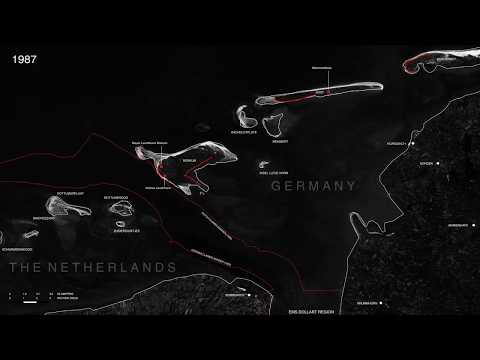
The unit will dwell on the juridical ambiguity of the North Sea – a scenario that generates the possibility of creating a state of exception: a spatio-temporal condition in which normality and the rule of law is suspended. Displacement, confinement, unlimited resource extraction, ecological crime, human incarceration and genocide are justified in this peculiar territory that exists ‘away and elsewhere’. Thus, one could claim that the ‘architecture of the sea’ – whether in the form of a military platform, a ship, a coastal settlement or invisible lines crossing multiple spatio-temporal jurisdictions – emerges before and outside of any specific appropriation.
This architecture exists within a reality of extreme, asymmetrical, disproportionate violence and colonial externality. It becomes a ‘liminal space’, which, in its formal separation from the rest of the world, presents a realm of instability and possibility. Within this framework, the sea stands at the centre of inter-European and global disputes. We claim that the North Sea should be seen as a politicised, territorial entity through which broader political, environmental, economic and societal questions can be addressed.
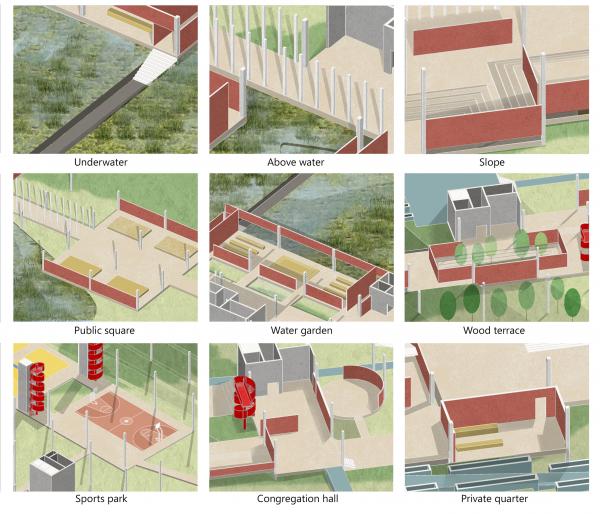
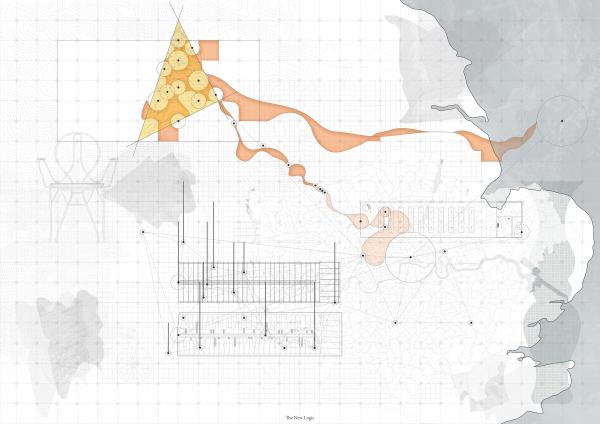
Diploma Unit 7 addresses these considerations through a year-long research-by-design project. Beginning with collective research that will inform individual projects, students will propose new spatial interventions to address the complex (yet not always visible) natures of the North Sea. The projects will envision possible futures for the region, informed not only by climate adaptation and clean energy futures, but also by political propositions. Students will therefore engage in micro and macro politics, from the scale of the body to that of the territory, exploring the ways in which any form of co-habitation conditions or is conditioned by the interaction between human and non-human environments and agents.