Experimental 12
Moon River
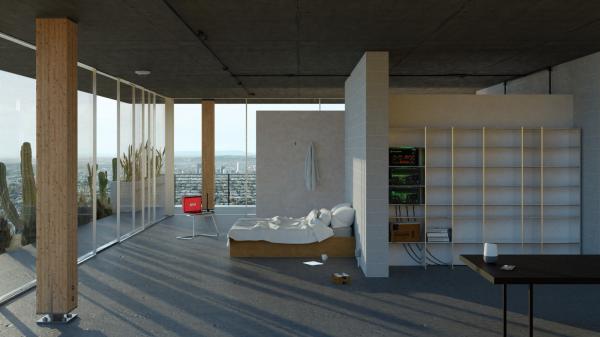
It is an understatement to say that information technology has fundamentally modified much of the world we navigate. Continuous connectivity between virtually every human being and device, simulated realities and machine learning are but a few variants of this technology. Architectural form and practice, however, seem to respond to the same imperatives of use and perception described in Walter Benjamin’s seminal essay The Work of Art in the Age of Mechanical Reproduction, published in 1935. EX12 will address these two imperatives and question their validity in the context of the current technological condition – a context in which humanity’s place is being challenged as never before.
We will focus on the scale of architecture and deal with form and matter. How do we build in a world in which visual appearance is mediated by omnipresent interfacing devices? What is materiality by default? How does automation affect our discipline? How can we partition space for populations whose behaviour can be predicted at an individual level, and how are buildings received (and thus conceived) if contemplation and habit are informed by the rate of computation? These are just some of the many questions we will address.
If technology and its implications are always present in the unit’s thought process, make no mistake: we will tackle architecture through its mass, its materiality and its ecological footprint – this design studio is strongly rooted in solid architecture.
Our methodology consists of a combination of skill acquisition and continuous project development. Participants in EX12 will familiarise themselves with a wide range of well-tested material, representational and spatial techniques in intense, collective workshop sessions, refining their distinct architectural approach through a year-long process of reactive, individual tutoring.
To apply this methodology, the unit will travel to California, where the focus will be on the critical observation of the notorious Case Study houses, the local geography and, last but not least, the impact of tech-driven economies in the Bay Area.