Homeostatic Urban Morphologies: An Evolutionary Model
Milad Showkatbakhsh
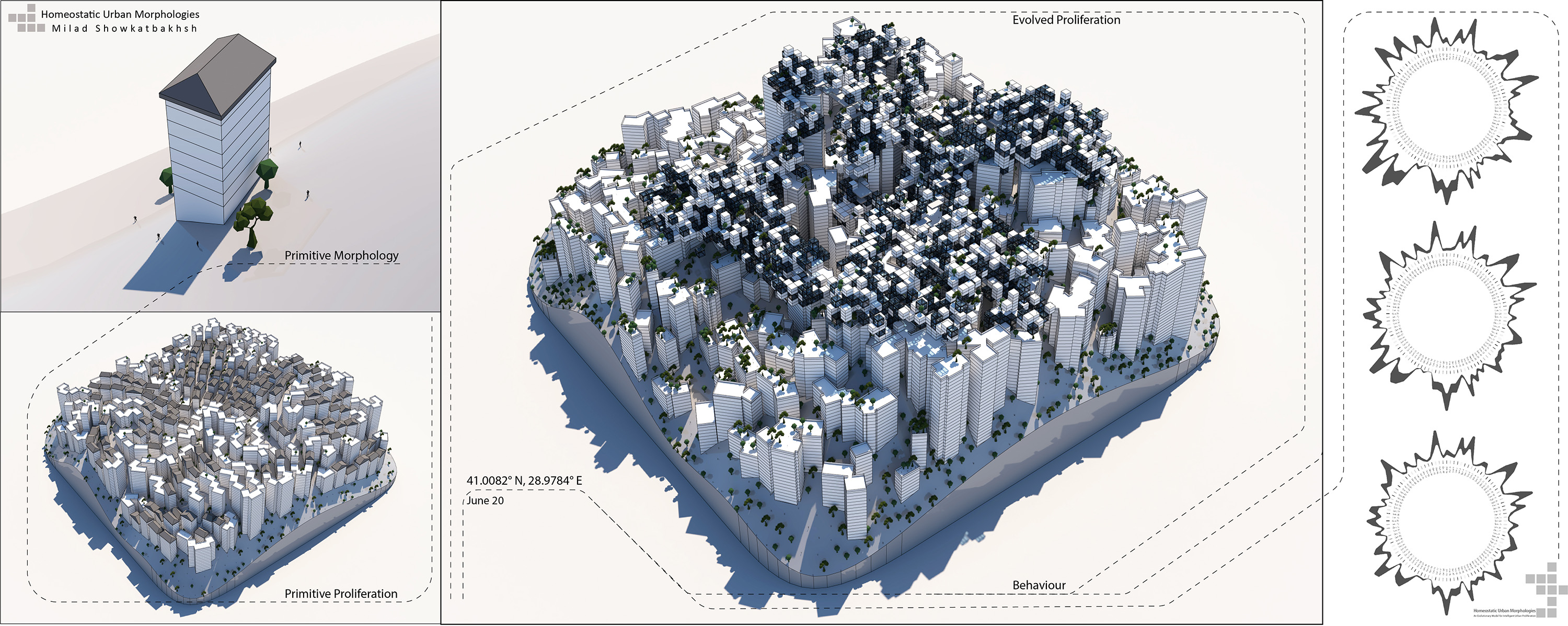
This research examines the potential of homeostatic principles, and their connection to the evolution of natural systems, to inform the design of urban morphological configurations across a range of temporal and spatial scales. Homeostasis is the term for the biological processes by which individual beings and collectives maintain steady-state in their environment, and there is a wide range of morphological and behavioural traits across multiple species that are rooted in their homeostatic behaviours. To examine and reflect on the interrelations of forms, processes, and behaviours can yield useful strategies for architectural design processes that require significant environmental performance enhancements. Although biomimicry has been established for many decades and has made significant contributions to engineering and architecture, homeostasis has rarely been part of this field of research. The ambition of this research is to abstract principles of homeostasis and its connection to the evolutionary development of natural systems. Furthermore, to define and develop those principles through a set of experiments to produce a computational design engine to generate testable mathematical models with a specified degree of mutability, or adaptation to differing circumstances or environments, together with an expository conceptual and computationally simulated design, evaluations and principles of implementation.