MA/MArch
Housing and Urbanism
Cities have faced a multitude of challenges and uncertainties this academic year, many of them global in magnitude and extent. While the Covid-19 pandemic has taken the spotlight over the first half of 2020, it stands against a backdrop of climate crisis, collapse of effective political leadership, social confrontation, and economic malaise. Many of our students faced tremendous disruption in their daily lives and have shown great capacity to persevere, adjust, and innovate. In many respects, this mirrors the urban process itself. Cities are experienced as myriad local situations, each demanding a forward perspective, calling for speculation, experimentation, and active learning. This is the legacy of cities: to define the form and institutional structure that will grant continuity amidst conflictual and persistently revolutionary forces.
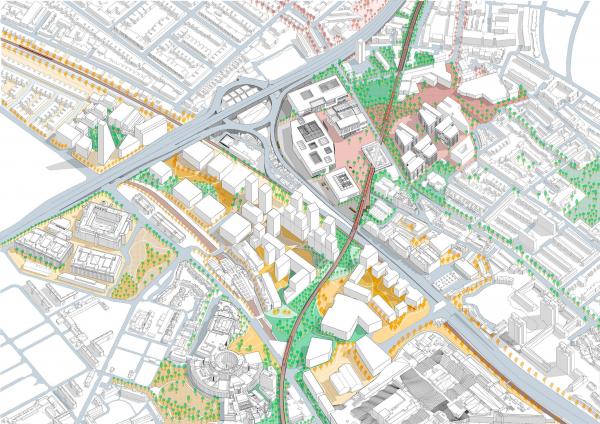
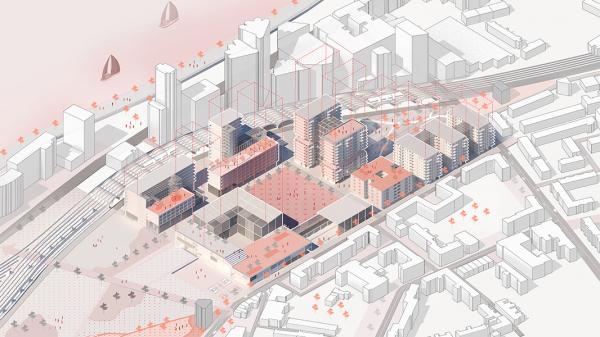
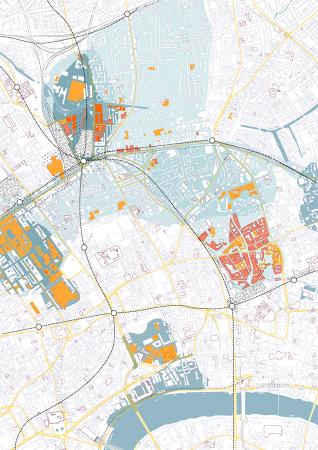
Many emerging urban patterns of the current pandemic and associated government policies appear to accelerate pre-existing tendencies. We are seeing renewed calls for local integration, for mutualism and solidarity, for a shift toward active mobility, a broadening and multiplication of services, and environmental sustainability. In their collective essence, the city being called for is pluralist, adaptive, innovative, and sets collective initiative and planetary wellbeing at its core. The H&U Studio is divided into three tutorial teams, each pursuing a separate brief within London – our primary learning laboratory – and all reflect this underlying attitude toward the city. In central London’s Pentonville area, we have been seeking enhanced integration and inclusivity, a stronger focus on building opportunity for deprived communities as the technology and media industries expand. In Barking, we sought a renewed spatial vision of the commons and procurement models which encourage greater participation in the urban process. In Brentford, we have been asking how the broad emphasis upon health, wellbeing, and the bioeconomy may be harnessed in favour of a more resilient and synergetic post-peripheral urbanity.
Programme Heads
Lawrence Barth
Jorge Fiori
Teaching Staff
Dominic Papa
Elena Pascolo
Irénée Scalbert
Anna Shapiro
Giorgio Talocci
Francesco Zuddas
Contributors
Lee Bennett
Katharina Borsi
Keith Bradley
Andreas Bründler
Merritt Bucholz
Alexandra Chechetkina
Sophie Delhay
Edouard Dembiermont
Elad Eisenstein
Alice Fenwick
Nick Ffoulkes
Françoise Fromonot
Graham Goymour
Platon Issaias
Raymonde Laluque
Selina Mason
Alicia Nahmad Vazquez
Umberto Napolitano
Rodrigo O’Malley
Mariia Pashenko
Pavlos Philippou
Alfredo Ramirez
Nathalie Regnier-Kagan
Ute Schneider
Charles Scott
Julian Siravo
Alexandre Theriot
Oliver Thill
Paul Vermeulen
Sophie Watson
Students
Nella Abi Khalil
Yasmina Aslakhanova
Michail Birman
Constanza Carrillo
Xiao Cheng
Lu Dai
Carolina Gilardi
Yu Guo
Arunima Gupta
Nawei Huang
Suhani Jain
Yi Jiang
Sungeun Jun
Humaira Kabir
Hilal Kuscu
Maitrey Kute
Karam Lee
Kit Lum
Mohamed Yousry Zakria Mohamed
Muriel Mulier
Seray Nergiz
Yuuki Noguchi
Alejandra Marlene Ortiz Rivas
Chandra Prajapati
Jiawen Qiao
Aayushi Rathi
Amerigo Ruta
Marina Samvelyan
Jingchao Sheng
Un Teng Sou
Stamatina Tharrouniati
Bingjie Wang
Tao Wang
Stefan Weber
Qiaoyi Wu
Jingyi Xu
Xi Yang
Daisuke Yoshida
Miao Yu
Zhou Yu
Shuya Zeng
Yaozhong Zhang
Lingxi Zhou
Xinrui Zhou
-HU_March_Jingchao_Shen_Assembling_Differance.jpg)
-MYZ_land reassembly.jpg)


-HUHumairaKabir01.jpg)
-20_YasminaAslakhanova_livingdifferently_04.jpg)