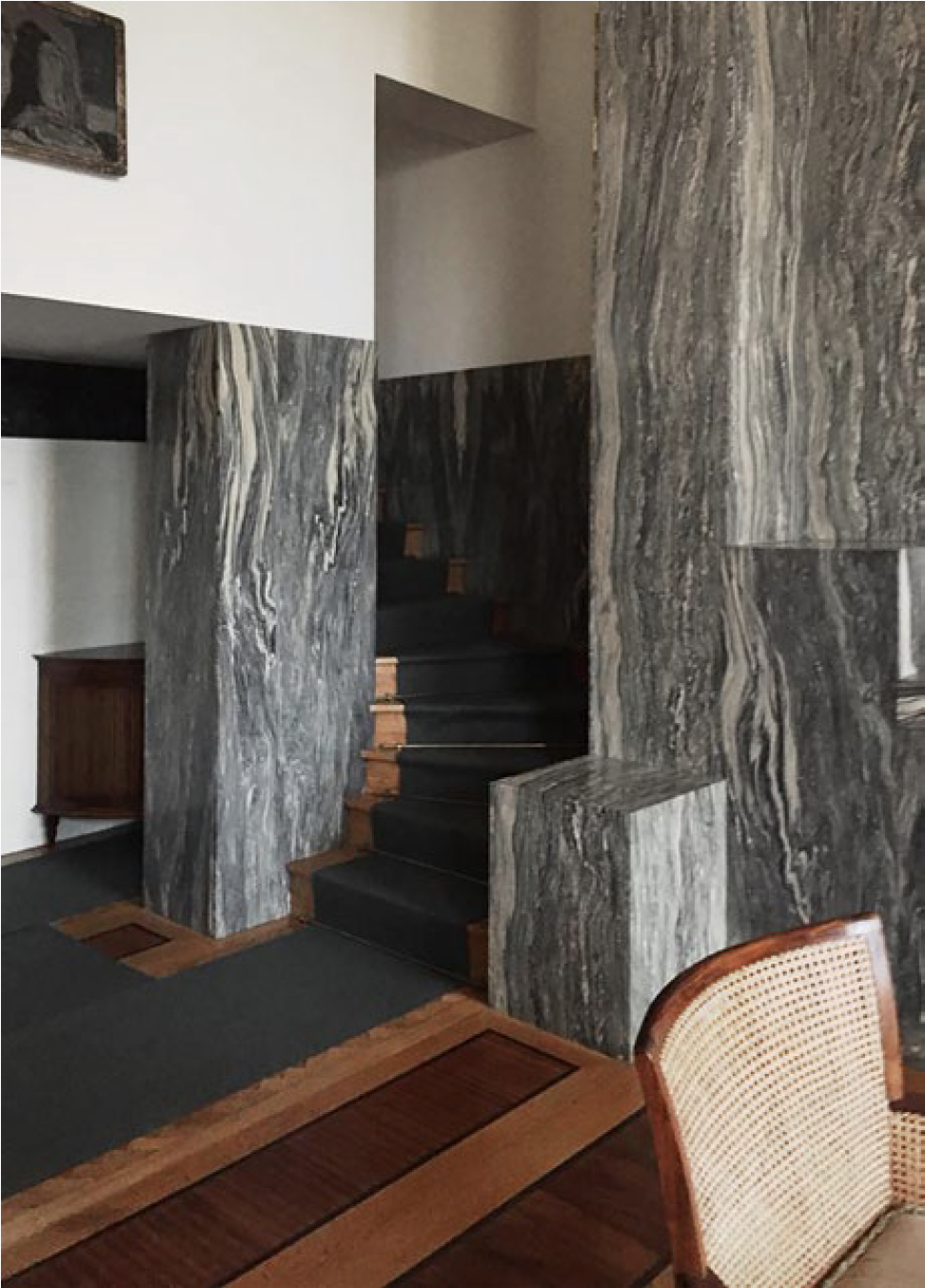
Comfort is a term that is well used but less known. It emerged in the 12th century as a mental- spiritual consolation endowed by religion, shifted in the 14th century to a strengthening of the body and its organs, adopted in the 17th century a familiarity to French bourgeois life, and surfaced as intellectual endeavor during Modernism. Thus, it is conditioned by a multitude of aspects; it is fluid, elastic and, most importantly, relative.
Comfort is to be found in the act of sitting (Rykwert, 1982), by dwelling on staircases (Perec, 1974) and through the event of opening the door rightly ( Frank, 1936). And as it is an element that occurs on a territorial scale (Chevrier, 2014) and alters according to cultures (Marshall, 2003), the study of comfort evolves into a rich discourse.
Interested not only in the various conceptual frameworks but also architectural concretions, the work of the Swedish-Austrian architect Josef Frank serves as exemplary. Situated within the modern discourse but concurrently taking a counterposition, Frank was a peer of Adolf Loos and predecessor of Hermann Czech. His work distinguishes itself through well-calibrated spatial sequences, generously formulated details and the concurrent stimulation of body and mind.